About Kevin Rudd
The Honorable Dr Kevin Rudd AC is a leading international authority on China. He currently serves as Global President and CEO of Asia Society in New York. Asia Society was established in 1956 and now operates across 16 centers with more than 250 staff around the world. Dr. Rudd is also Founding President of the Asia Society Policy Institute, a “think-and-do tank” focused on global engagement with Asia, and the Founding Chair of its Center for China Analysis.
Dr. Rudd returned to lead Asia Society in March 2026 following three years as Australia’s Ambassador to the United States under the Trump and Biden Administrations. He previously served as Australia's 26th Prime Minister from 2007 to 2010 and as Foreign Minister from 2010 to 2012, before returning as Prime Minister in 2013.
He has published two books on China and US-China relations, On Xi Jinping (OUP, 2024) and The Avoidable War (Hachette, 2022). Dr. Rudd is proficient in Mandarin Chinese, having graduated in Chinese language and history from the Australian National University. In 2022 he was awarded his DPhil from Oxford University for his dissertation on Chinese President Xi Jinping’s ideological worldview.
Over the years, he has been extensively cited on China, appearing frequently on U.S. network and cable television and the BBC. He has written extensively in the international print media including TheWall Street Journal, TheNew York Times and The Financial Times, and across the major outlets in India, Japan, France, Germany and across Europe. Most recently, he appeared on Ezra Klein's podcast to discuss Xi Jinping, and on Gideon Rachman's podcast to discuss U.S.-China relations.
In Government
As Prime Minister, he led Australia’s response during the Global Financial Crisis, reviewed by the IMF as the most effective stimulus strategy of all member states. Australia was the only major developed economy not to go into recession. Mr. Rudd co‑founded the G20 to drive the global response to the crisis, which in 2009 helped prevent the crisis from spiraling into depression.
As Prime Minister and Foreign Minister, Mr. Rudd was active in global and regional foreign policy leadership. He was a driving force in expanding the East Asia Summit to include both the U.S. and Russia in 2010, and launched the long-term concept of transforming the EAS into a wider Asia Pacific Community. On climate change, Mr. Rudd ratified the Kyoto Protocol in 2007 and legislated in 2008 for a 20 percent mandatory renewable energy target for Australia. He represented Australia at the 2009 Copenhagen Climate Change Summit which produced the Copenhagen Accord, for the first time committing states to not allow temperature increases beyond two degrees. He was appointed a member of the UN Secretary-General’s High Level Panel on Global Sustainability and is a co-author of the report Resilient People, Resilient Planet for the 2012 Rio+20 Conference. This report was the first to recommend the negotiation of the Sustainable Development Goals.
Mr. Rudd drove Australia’s successful bid for its non-permanent seat on the United Nations Security Council for 2012-2014. His government also saw the near doubling of Australia’s foreign aid budget to approximately $5 billion, making Australia then one of the top ten aid donors in the world. He also appointed Australia’s first ever Ambassador for Women and Girls to support the critical role of women in development and reduce physical and sexual violence against women.
Domestically, Mr. Rudd delivered Australia’s formal national apology to indigenous Australians. In education, his government introduced Australia’s first-ever nationwide school curriculum, undertook the biggest-ever capital investment program in Australian schools with the building of thousands of new state of the art libraries across the country, as well as introducing the first-ever mandatory national assessment system of literacy and numeracy standards. In health, Mr. Rudd in 2010 negotiated with the Australian states a National Health and Hospitals Reform Agreement, the biggest reform and investment in the health system since the introduction of Medicare 30 years before. His government established a national network of leading-edge cancer care centers across Australia, before introducing the world’s first ever plain-packaging regime for all tobacco products. To improve the rate of organ and tissue donation, he established Australia’s first National Organ and Tissue Transplant Authority. In 2010, his government introduced Australia’s first-ever paid parental leave scheme and implemented the biggest increase in, and reform of, the age pension since federation. He also founded the National Broadband Network to deliver high-speed broadband for every household, business, school, hospital, and GP in the country.
In 2019, Kevin was appointed a Companion of the Order of Australia for eminent service to Indigenous reconciliation, innovative economic initiatives, and major policy reform, and through senior advisory roles with international organisations.
Earlier career
Kevin started his diplomatic career in 1981 with postings to Beijing and Stockholm. In 1988, he was appointed Chief of Staff to the Hon. Wayne Goss and served him as Premier of Queensland. He was Director-General of the Cabinet Office from 1991 to 1995, and Senior China Consultant for KPMG from 1996 to 1998. He served in the Australian House of Representatives as the Member for Griffith between 1998 and 2013. He graduated with Honours in Asian Studies from the Australian National University and received his DPhil from Oxford University in 2022. He also studied at National Taiwan Normal University in Taipei. He is the author of a two-volume autobiography, Not for the Faint-Hearted and The PM Years.
Kevin and his wife Thérèse Rein are the proud parents of three and grandparents of three.

Kevin with his wife Thérèse, daughter
Jessica and granddaughter Josephine

Prime Ministers Kevin Rudd,
Anthony Albanese and Paul Keating
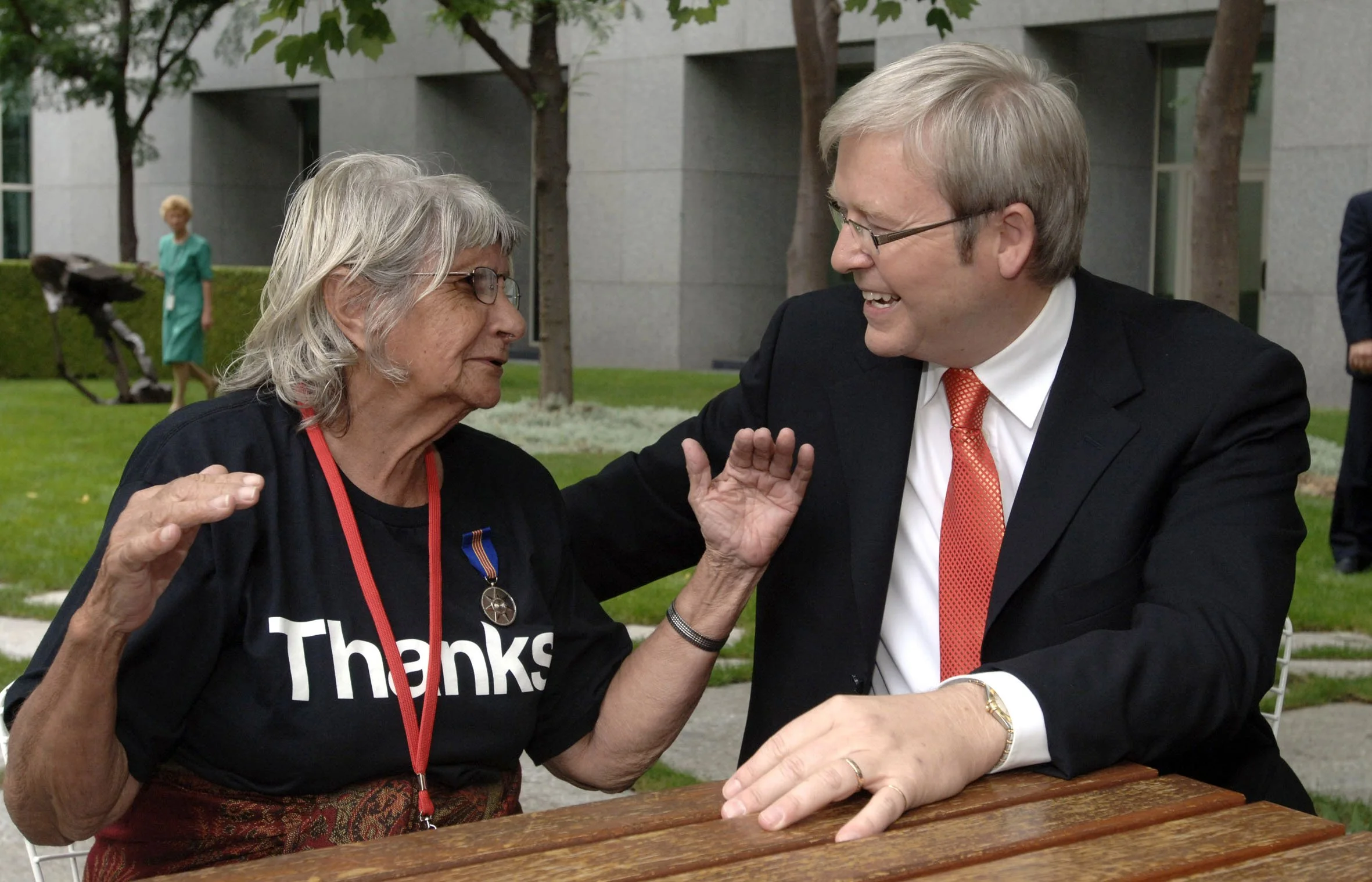
Kevin with Nana Nangala Fejo after he delivered
the Apology to Australia’s Indigenous Peoples