The Vision for Asia-Pacific Community: Renmin University
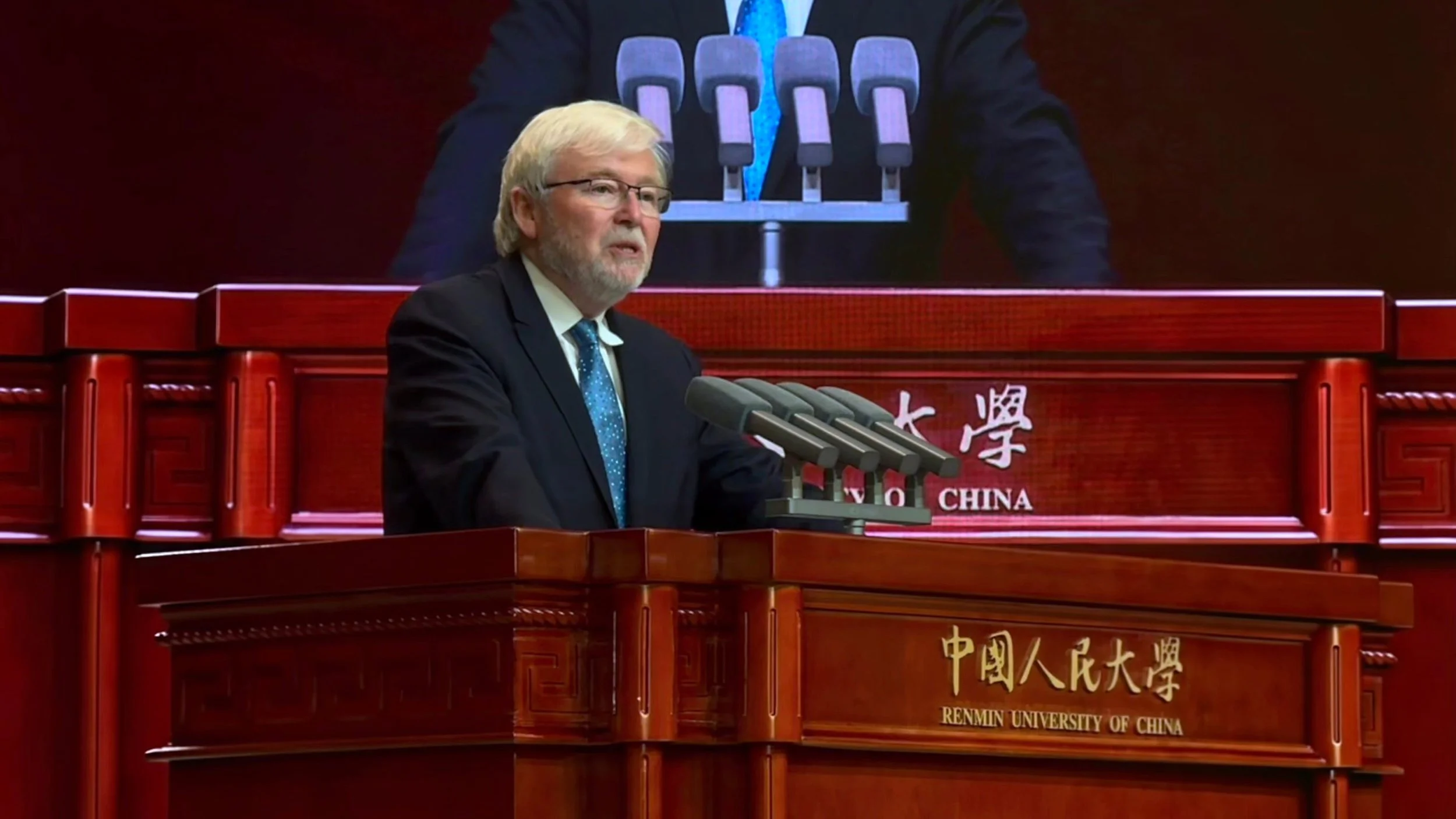
The Hon Kevin Rudd AC
Global Development Forum
Renmin University, China
12 October 2026
Ladies and gentlemen, friends,
Secretary Zhang, President Ma, Vice President Zheng, distinguished leaders and guests,
It is a great pleasure to be back in China.
I first came here more than forty years ago, as a young Australian diplomat, in the early years of reform and opening.
I have spent most of my adult life since trying to understand China, the United States, and the extraordinary region we share.
In June 2008, as Prime Minister of Australia, I put forward an idea in a speech to the Asia Society in Sydney on the need to build an Asia-Pacific Community.
Eighteen years later, China has chosen as the theme of its APEC year: “Building an Asia-Pacific Community to Prosper Together.”
You will understand why that caught my attention.
And 18 years later, I now head the same Asia Society that I spoke to back then in Sydney.
My argument back in 2008 was simple.
Our region was changing faster than the institutions we had built to manage it.
Back then, I pointed to the projected numbers for 2020: some 60 per cent of the world’s people, around 45 per cent of global GDP, a third of global trade and, less comfortably, close to a quarter of the world’s military spending.
Not every forecast landed exactly.
Today, Asia and the Pacific is home to around 4.8 billion people — some 58 per cent of the world’s population.
The region accounts for around 40 per cent of global GDP, and Asia was responsible for more than 70 per cent of the growth in global merchandise trade last year.
Looking further ahead, under the Asian Development Bank’s “Asian Century” scenario, by 2050 Asia could account for around half of global GDP — and more than half of global trade and investment.
I may not have got it right on all the details, but the overall direction was broadly right.
The global centre of gravity has indeed now moved to Asia and the wider Asia-Pacific.
The simple mathematics of our combined militaries, economies, trade, investment, capital markets, technologies and carbon footprints means that how we manage this region’s future will now determine the world’s future.
So we now have both a regional and global responsibility to manage effectively the political, security, economic, technological and environmental challenges of this critical theatre for the world.
Back then I pointed to a gap in the region’s institutional architecture for dealing with the future challenges we faced.
APEC, which first met at Summit level in 1993, brought the region’s economies together, but had no mandate for political and security questions. Moreover, India was not a member.
The East Asia Summit, founded in 2005, had that mandate, but the United States was not in the room.
In other words, no single table had all the major powers around it capable of addressing the breadth of the economic and security challenges and opportunities we faced.
So I proposed that together we build an Asia-Pacific Community by 2020: spanning the whole region, China, the United States, Japan, India, Indonesia and all the others, with ASEAN at its core.
As I said explicitly back then, it was never intended as some form of political, economic or monetary union.
And in security policy terms, it was never directed against any country.
It was something more practical: to build the habits of dialogue and cooperation before we needed them in a crisis, not after.
My special envoy then spent a year consulting across the region.
The message that came back was clear: yes to the conversation, no to another institution and yet more meetings. I listened. The answer was to adapt the institutions we already had.
And that is what happened. In Bali in 2011, the United States and Russia took their seats at the East Asia Summit: eighteen countries, all the major powers, with ASEAN in the chair.
And in 2020, the year that I had named back in 2008, APEC leaders adopted the goal of “an open, dynamic, resilient and peaceful Asia-Pacific community by 2040.”
History did not follow any particular timetable. It rarely does. But the idea did not disappear.
Now China, hosting APEC for the third time, has put that goal at the centre of its year in the chair.
And it has chosen Shenzhen: a fledgling special economic zone when I first arrived in China, with a population of only thirty thousand.
Today, Shenzhen has become one of the great technology cities of the world.
It is fitting in this age of artificial intelligence that APEC leaders will meet there.
A regional community cannot be built by one country alone.
But it cannot be built without China.
Nor can it be built without the United States, which by geography and history is a Pacific power.
There is a phrase from the Confucian Analects that I have always liked: 和而不同 (hé ér bù tóng). Harmony without uniformity.
Our various countries have different political systems, different histories, different cultures and often but not always different interests.
Those differences are not going away.
Nor is strategic competition, least of all between China and the United States, going to go away.
But competition need not become confrontation.
And confrontation must never become war.
That is what I have called managed strategic competition, and the important word is “managed”.
The alternative is unmanaged strategic competition which can be a risk to regional stability.
We at the Asia Society have preached this gospel for more than a decade now, through one major report after another.
President Xi and President Trump have agreed this year to a new framework for their bilateral relationship of constructive strategic stability, with respect, fairness and reciprocity.
They also agreed to meet again in Shenzhen next month, their third meeting this year.
Whatever name we may give to our aspirations, the test is the same.
Can we work together on the problems that no country can solve alone?
And can we evolve regional institutional arrangements that can accommodate our common challenges and opportunities?
Let me name three.
First, the safety and security of artificial intelligence.
In Chinese, one word covers both: 安全 (ān quán).
On AI, we need both.
In 2008, I said our region was changing faster than our institutions.
Artificial intelligence is changing faster than anything I have seen in public life.
The most advanced AI models can now find weaknesses in the cyber defences of the software the world runs on.
In the wrong hands, they could help to shut down a power grid, a water system, a financial network, or design a pathogen.
And a failure in one country will not stay in one country.
Moreover, if an attack occurs, how do we attribute the origin of the attack in order not to blame states that were not responsible?
Furthermore, we now face the real-world risk of AI agents acting autonomously to access systems without authorisation and potentially to attack those systems and cause them to collapse.
These are real-world, critical and urgent problems both for our region and the wider international community today.
There is, however, something to build on.
In Lima two years ago, on the margins of APEC, the presidents of China and the United States agreed that human beings, not machines, must control any decision to use nuclear weapons.
This year the two presidents agreed to open a dialogue on dangerous AI and super intelligence.
The region should aim to go further: common standards for testing the most powerful systems before they are released; a channel to warn each other quickly when something goes wrong; agreements on what to do both to prevent any such attack; agreements on what to do when such an attack has occurred; and protocols for notification, attribution and most critically verification.
AI security and safety are not just an American interest.
Or just a Chinese interest.
It is a human interest for the whole world.
An Asia-Pacific Community could embrace this common AI challenge as part of a much wider set of confidence and security building measures to deal with the broader range of common security challenges faced by the region at large.
Establishing the habits and patterns of security cooperation is much needed for our region’s future.
And at present we do not have the pan-regional institutional practices to do so.
Second, our regional institutions need to deal with the impact of climate change on the economies of our region.
The economies of APEC use around 60 per cent of the world’s energy.
And for our neighbours in the Pacific islands, climate change is not a question of economics. It is a question of survival.
Our region will therefore have a global responsibility to act on the great energy transition that follows from our national commitments under the Paris Agreement of 2015.
What happened in Nepal and China last month with a glacial collapse and the resulting loss of life is what happens when we all fail to act.
It’s a grim reminder of what lies ahead for the rest of this century as global temperatures rise by a staggering three degrees centigrade as carbon mitigation efforts fail.
The economic cost to nations will be unprecedented. In extreme weather events. In water supply. In agriculture. In households as the costs of insurance rise beyond the reach of average families. And in refugees.
Climate is a multidimensional threat: a combined security challenge, an economic challenge, a technological challenge, and an environmental challenge.
Climate change, the clean energy transition, and effective demand-side management turbocharged by AI represent a core agenda item for a future Asia-Pacific Community.
In the same fortnight that APEC leaders meet in Shenzhen, the world’s climate negotiators will meet in Antalya for the Conference of the Parties under the UNFCCC, with Australia chairing the negotiations. The two meetings should speak to each other.
The purpose of pan-regional collaboration is to reinforce the global mandate of the UNFCCC, not to detract from it.
Although we should remember that it will be regional states that will be called upon first to deal with the unfolding consequences of climate change as it cuts a swathe across our peoples.
Developing the habits of regional co-operation in this critical domain can create the political space and capital over time to address other pressing regional economic, environmental, and social challenges into the future.
Third, human security, public health, and above all, responding to the challenge of cancer.
Cancer kills about ten million people every year.
More than half of them are in Asia.
Yet fewer than one patient in twenty ever has access to a clinical trial.
And a medicine proven in one country can take years to reach patients in another, because the trial has to be run all over again.
That is why, at the Asia Society, we have worked with partners across the region on an initiative we call Cure4Cancer.
The idea is simple. Run clinical trials across borders. Align the standards that regulators use to judge them, while each regulator keeps its own authority.
This brings new treatments to patients years sooner.
A Chinese breakthrough that saves an American patient is not an American defeat.
An American medicine that saves a Chinese life is not a Chinese defeat.
Cancer does not check passports.
APEC already has the machinery to align the regulation of medicines.
If we are crafting a vision for a wider Asia-Pacific Community, then these fundamental questions of human security which affect all our peoples would enhance the political legitimacy of all our governments.
The safety and security of artificial intelligence.
The security, economics and human impact of climate change.
Together with the wider human security and public health challenges that face us all.
None of them respects borders.
None of them can be solved by one country.
And each of them gives the word “community” a meaning that ordinary people can understand.
There is a Chinese saying about people in the same boat helping each other across the river:
同舟共济(tóng zhōu gòng jì)。
But it is not enough to be in the same boat.
We also have to row in the same direction.
Our differences are real.
Our interests are not identical.
Our strategic competition will not disappear.
But none of this makes conflict inevitable.
And none of this makes co-operation impossible.
What our region needs, therefore, is a shared sense of ownership of its own future.
Not an American Asia.
Not a Chinese Asia.
But an Asia-Pacific in which every country, large and small, has a legitimate place.
The idea of an Asia-Pacific Community represents an unfinished vision.
It is an unfinished project.
And one that is still worth building.
The hour may be late. But it’s still not too late.
For these reasons, I wish China well in its hosting of APEC this November as together we explore what an Asia-Pacific Community might mean for our common future.